

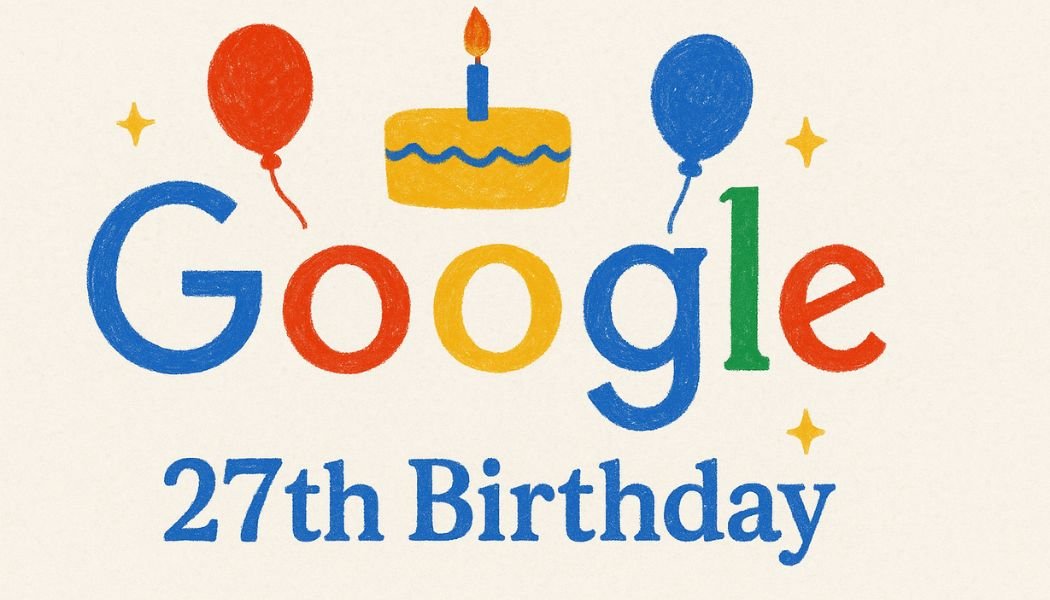
On 27 September 2025, the world’s most visited website turned 27. Google’s 27th birthday wasn’t just another milestone it was a nostalgic celebration that looked back at where it all began while embracing the digital future the company continues to shape.
Visitors to Google’s homepage were greeted by a special Google Doodle, featuring the company’s original 1998 logo. For millions of users across the UK, US, and beyond, it offered a charming glimpse into the early internet, a simpler time when search engines were new, and the idea of “Googling” something didn’t yet exist.
From a Garage to Global Greatness
The story of Google starts in 1998, inside a garage in Menlo Park, California. Two Stanford University students, Larry Page and Sergey Brin, set out to build a search engine that could make sense of the rapidly expanding World Wide Web. Their goal was ambitious: to organise the world’s information and make it universally accessible and useful.
The prototype of Google wasn’t called Google at first; it was named BackRub, a system that analysed web links to rank websites by importance. This unique approach to sorting results would soon revolutionise how people find information online.
The garage, rented from Susan Wojcicki (who would later become YouTube’s CEO), became the birthplace of an idea that would change how the world connects, learns, and communicates.
What Was Google’s Real Name? The Story Behind “Google”
Few people know that “Google” came from a playful misspelling of the word “googol,” a mathematical term meaning the number 1 followed by 100 zeros. The term perfectly captured Larry and Sergey’s vision: a search engine capable of indexing a seemingly endless amount of information.
When a friend accidentally wrote “Google” instead of “Googol”, the founders loved the quirky mistake and the name stuck. It was unique, catchy, and easy to remember, perfectly matching the innovative and curious spirit that would come to define the company.
Why Google Celebrates Its Birthday on 27 September
Although Google was officially incorporated on 4 September 1998, the company has celebrated its birthday on 27 September since the mid-2000s.
The reason goes back to a key moment in the company’s history: around that time, Google announced a major milestone in its search index growth, marking a significant leap in its ability to process and catalogue the web.
That milestone became a symbolic anniversary, representing Google’s transformation from a university project to a global powerhouse. Every year since, the company has marked 27 September as its official birthday — a date now celebrated by millions of internet users worldwide.
The 27th Birthday Doodle: A Trip Down Memory Lane
This year’s Google Doodle was a heartfelt nod to the past. The homepage featured Google’s original 1998 logo, the one that first appeared when the search engine launched. The Doodle was designed to stir nostalgia, reminding users of the early days of the internet, when dial-up connections and chunky monitors ruled the digital world.
Rather than using modern animations, Google kept the artwork simple, almost vintage in style. It reflected how far the company has come from a basic search page to a vast technology ecosystem that now includes YouTube, Gmail, Android, Maps, and AI tools like Gemini.
Google Doodles have always served as creative snapshots of culture, science, and history. But the birthday editions, especially this one, feel more personal, celebrating not just innovation, but identity.
27 Years of Growth and Innovation
In 1998, Google processed around 10,000 searches per day. Fast forward to 2025, and that number has skyrocketed to an estimated 13.6 billion searches daily, nearly 5 trillion searches every year.
What began as a simple search engine is now a global digital ecosystem:
- Gmail (2004) revolutionised email communication.
- YouTube (acquired in 2006) became the world’s largest video platform.
- Google Maps (2005) changed how we navigate and explore.
- Android (2008) powers billions of smartphones worldwide.
- Google Drive, Docs, and Meet reshaped online productivity.
Today, Google’s reach extends into nearly every aspect of digital life, from cloud computing and AI to sustainability and quantum technology. Its parent company, Alphabet Inc., is now valued at over $3 trillion, making it one of the most powerful entities in the global tech industry.
How Google’s Culture Shaped Its Success
Behind every product launch and innovation lies Google’s distinctive workplace culture. From the beginning, the company encouraged creativity, experimentation, and curiosity.
Employees were once given the famous “20% time” policy the freedom to spend a fifth of their working hours on personal projects that could benefit the company. This policy led to the creation of some of Google’s biggest successes, including Gmail and AdSense.
This culture of openness and experimentation continues to drive Google’s forward momentum. Even as it becomes a tech giant, the company retains that start-up spirit, one that celebrates ideas, exploration, and bold thinking.
Birthday Deals and Special Offers
To mark its 27th anniversary, Google also introduced limited-time discounts through the Google Store, offering savings on products like the Pixel 9 smartphone, Pixel Watch 3, and Nest smart devices.
These deals are more than marketing; they’re a way to connect with users and say thank you. Google’s hardware has become an essential part of daily life for millions, from the smart devices that manage homes to the phones that capture memories.
Google’s Impact on Everyday Life
It’s nearly impossible to imagine life in the UK or the US, or anywhere without Google. Whether you’re searching for a restaurant, checking the weather, learning a new skill, or streaming YouTube, Google is deeply embedded in everyday routines.
Its mission, “to organise the world’s information and make it universally accessible and useful,” remains unchanged, even as the scale of that mission has grown beyond imagination.
From the Chrome browser on your laptop to Google Maps in your car, and from Android apps to AI assistants, the company continues to redefine how people interact with technology.
Looking Ahead: The Future of Google
As Google enters its 28th year, its focus is clear: to lead the next era of technology through artificial intelligence, sustainability, and inclusion.
The rise of AI-powered Search, Gemini AI, and Google Cloud signifies a shift toward a smarter, more integrated digital future. Meanwhile, the company’s environmental ambitions to operate entirely on carbon-free energy by 2030 show its commitment to a sustainable planet.
But even as it explores quantum computing and next-gen AI, Google continues to hold onto the same philosophy that started it all: the belief that knowledge should be open, accessible, and empowering for everyone.
Conclusion: A Celebration of Curiosity and Creativity
Google’s 27th birthday wasn’t just about a nostalgic logo or a milestone number. It was a celebration of curiosity, creativity, and the power of ideas.
From a dusty garage to global dominance, Google’s story is a testament to how innovation can transform the world. The playful misspelling that became one of history’s greatest brands reminds us that sometimes, the biggest revolutions begin with the smallest spark.
As users clicked on the Doodle this September, they weren’t just celebrating a company; they were celebrating a journey that continues to shape the way we live, learn, and connect every single day.