

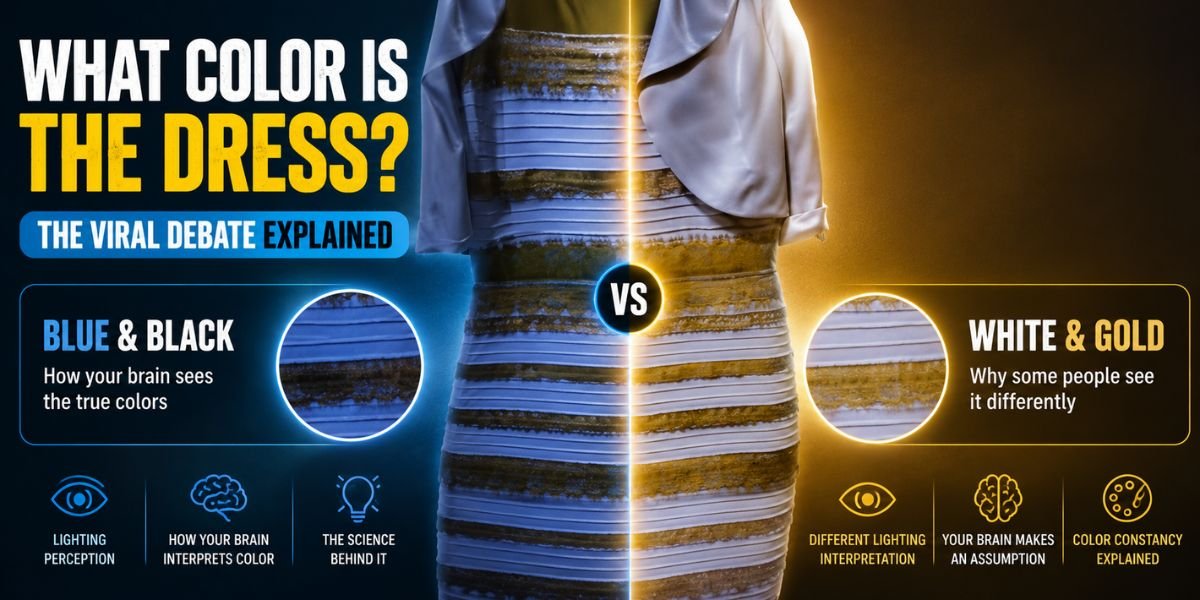
What Color Is the Dress?
If you’ve ever wondered “What color of dress?”, you’re not alone. The famous dress photo became one of the biggest internet debates of all time. While some people instantly saw a blue and black dress, others were convinced it was white and gold.
The disagreement wasn’t a joke or a trick. It was a real example of how the human brain interprets light and color differently. Even today, years after the image first went viral, millions of people continue searching for the answer.
In this guide, you’ll discover:
- Why people see different colors
- The real color of the dress
- The science behind the illusion
- Why the debate became a global phenomenon
- Interesting facts you may not know
Quick Answer
The actual dress is blue and black.
However, depending on how your brain interprets the lighting in the photograph, you may perceive it as white and gold. This happens because the brain constantly adjusts colors based on what it believes the surrounding light source is.
Why Did the Dress Go Viral?
The image first appeared online in 2015, when a user posted a photograph asking friends what color they thought the dress was.
Within hours:
- Millions of people were debating the answer.
- Celebrities joined the discussion.
- Scientists began studying the image.
- News outlets around the world covered the story.
It quickly became one of the most famous internet optical illusions ever shared.
What Is the Real Color of the Dress?
The manufacturer confirmed that the dress was actually:
- Blue fabric
- Black lace
The confusion came entirely from the lighting conditions in the photograph—not from the dress itself.
When the image is edited to correct its exposure and white balance, the blue and black colors become much easier to recognize.
Why Do Some People See White and Gold?
The answer lies in something called color constancy.
Your brain is constantly trying to determine what type of lighting is falling on an object.
For example:
- If your brain assumes the dress is in a shadow, it mentally removes blue light, making the dress appear white and gold.
- If your brain assumes the dress is under warm indoor lighting, it subtracts yellow light, making the dress appear blue and black.
Neither group is “wrong”—their brains are simply interpreting the scene differently.
The Science Behind the Dress Illusion
Human vision isn’t like a camera.
Instead of recording colors exactly as they exist, your brain continuously adjusts them based on:
- Brightness
- Shadows
- Light source
- Background colors
- Surrounding environment
This process usually helps us recognize objects correctly in everyday life.
The dress photograph confused this system because it lacked clear information about the lighting conditions, forcing every brain to make its own assumptions.
How Does Your Brain Decide the Dress Color?
When you look at the famous dress photo, your eyes collect light, but your brain decides what color you actually see.
This happens because our visual system automatically adjusts for different lighting conditions—a process known as color constancy. It’s the same reason a white shirt still looks white whether you’re outside in sunlight or inside under warm indoor lighting.
The dress photo confuses this process because the lighting is unusually ambiguous. Your brain has to “guess” the light source, and that guess determines the colors you perceive.
Why Do Some People See Blue and Black?
People who perceive the dress as blue and black are generally interpreting the image as being illuminated by warm, yellowish indoor lighting.
Their brains mentally subtract the warm tones, revealing what appears to be the dress’s true colors:
- Blue fabric
- Black lace
This interpretation matches the dress’s actual physical colors.
Why Do Others See White and Gold?
Those who see white and gold usually assume the dress is in cool daylight or heavy shadow.
To compensate, the brain removes bluish tones from the image, making the fabric appear white while the darker lace appears golden or brown.
Neither interpretation is a vision problem—it’s simply your brain making a different assumption about the lighting.
Can the Dress Change Color?
Many people report that the dress seems to change colors over time.
For example:
- At first, they see white and gold.
- Later, they see blue and black.
- Some can switch between both interpretations depending on how they view the image.
This happens because your brain’s interpretation of the lighting can change based on:
- Screen brightness
- Display quality
- Ambient room lighting
- Viewing angle
- Visual focus
- Fatigue
What Did Scientists Discover?
After the image went viral, researchers from several universities studied why people disagreed.
Their findings suggested that factors influencing color perception include:
- Age
- Previous visual experiences
- Exposure to natural daylight
- Individual differences in visual processing
Researchers concluded that the dress became one of the best real-world examples of how the human brain interprets color rather than simply recording it.
Did Eye Color Matter?
Some online rumors claimed eye color determined what people saw.
There is no strong scientific evidence supporting this claim.
Instead, researchers found that lighting assumptions and individual brain processing play a much larger role than eye color itself.
Why Did the Debate Become So Popular?
The dress spread across social media because almost everyone believed their answer was obviously correct.
Friends, families, coworkers—even scientists—disagreed.
Within days:
- Millions of tweets were posted.
- Facebook discussions exploded.
- News organizations covered the story worldwide.
- Celebrities joined the debate.
The mystery became one of the biggest viral internet moments of the decade.
Celebrities Who Joined the Debate
Many well-known personalities shared their opinions online, including:
- Taylor Swift
- Kim Kardashian
- Kanye West
- Justin Bieber
- Ellen DeGeneres
- Mindy Kaling
Their posts helped introduce the dress debate to millions of additional people.
Similar Optical Illusions
The viral dress inspired interest in other famous internet illusions, including:
The Sneaker Illusion
Some viewers saw the shoe as pink and white, while others saw it as gray and green.
Yanny vs. Laurel
Although related to sound instead of vision, this viral debate showed how different brains can interpret the same information differently.
The Spinning Dancer
A silhouette that appears to rotate in different directions depending on how your brain processes motion.
The Checker Shadow Illusion
Two identical shades appear completely different because of surrounding shadows.
These examples demonstrate that perception is influenced by the brain—not just the eyes.
Why Is the Dress Still Popular in 2026?
More than a decade later, people continue searching for:
- What color is the dress?
- Is the dress blue and black?
- Why do I see white and gold?
- Dress illusion explained
The image remains a classic example used in psychology, neuroscience, photography, and education to explain how human perception works.
Common Myths About the Dress
Even years after the image went viral, several myths continue to circulate online. Here are the facts.
Myth 1: The Dress Actually Changes Color
False.
The dress never changes color. The physical garment is blue with black lace. What changes is how your brain interprets the lighting in the photograph.
Myth 2: People Who See White and Gold Have Better Eyesight
False.
Scientific studies have found no evidence that one group has better vision than the other. The difference is related to perception, not eyesight.
Myth 3: Your Phone Changes the Dress Color
Partly True.
Different screens, brightness settings, color calibration, and ambient lighting can influence how the image appears, but the biggest factor is still your brain’s interpretation of the scene.
Myth 4: Only Young People See White and Gold
False.
People of all ages have reported seeing both color combinations. Some research suggests age may influence perception slightly, but there is no fixed rule.
Fun Facts About the Viral Dress
- The debate began in February 2015 and spread worldwide within hours.
- Millions of people searched online to find the “correct” answer.
- News organizations across the globe covered the story.
- Universities used the image to teach students about color perception.
- Scientists published research inspired by the viral photo.
- The dress remains one of the internet’s most famous optical illusions.
Why This Optical Illusion Is So Important
The dress showed that two people can look at the exact same image and genuinely experience different colors.
It became a powerful reminder that our brains don’t simply record reality—they interpret it. This insight has applications in psychology, neuroscience, photography, design, and even computer vision.
The phenomenon also sparked widespread public interest in how human perception works, making complex scientific concepts accessible to millions.
FAQs
What color is the dress really?
The original dress is blue and black. The manufacturer confirmed these are its actual colors.
Why do I see white and gold?
Your brain is likely interpreting the image as being lit by cool daylight or shadow, causing it to mentally adjust the colors.
Why do other people see blue and black?
Their brains interpret the lighting differently, making the dress appear closer to its real colors.
Can people switch between seeing both versions?
Yes. Some people report seeing both color combinations at different times, depending on lighting, screen settings, or how they focus on the image.
Is the dress an optical illusion?
Yes. It is considered one of the most famous examples of an optical illusion caused by ambiguous lighting and color perception.
Did scientists study the dress?
Yes. Researchers used the viral image to better understand how humans perceive color and how the brain compensates for different lighting conditions.
Is there a right or wrong answer?
The physical dress is blue and black, but seeing white and gold is a normal result of the brain’s interpretation of the photograph.