

If you’ve ever bought a ring online only to have it show up too tight to get past your knuckle — or so loose it spins around your finger — you already know why getting the size right matters. Whether you’re surprising someone with an engagement ring, replacing a ring that no longer fits, or just shopping online where you can’t try before you buy, learning how to measure ring size at home can save you a return shipment, a resizing fee, and a lot of frustration.
The good news: you don’t need a jeweler on speed dial. With a few household items and about ten minutes, you can get a size that’s accurate enough for most purchases.
Quick Answer
The fastest reliable method: wrap a strip of paper or string around the base of the finger, mark where it overlaps, measure that length in millimeters, and match it to a ring size chart. For best accuracy, measure at the end of the day when fingers are slightly larger, and measure 3 times to confirm consistency.
Why Getting Ring Size Right Matters
A ring that’s even half a size off can be uncomfortable to wear daily, and resizing isn’t always simple. Some ring styles — especially those with eternity bands, inlays, or intricate settings — can be difficult or impossible to resize without damaging the design. Knowing your size (or someone else’s) before you buy avoids that headache entirely.
What You’ll Need
- A strip of paper (about 1/2 inch wide) or a piece of string/dental floss
- A ruler or measuring tape (one that shows millimeters)
- A pen or marker
- A printable ring size chart (many jewelers offer free ones online) or a ring sizer app
Skill Level: Beginner — no special skills required
Estimated Time: 5–10 minutes
Cost: Free, using items you likely already have at home
Step-by-Step: Measuring Ring Size with Paper or String
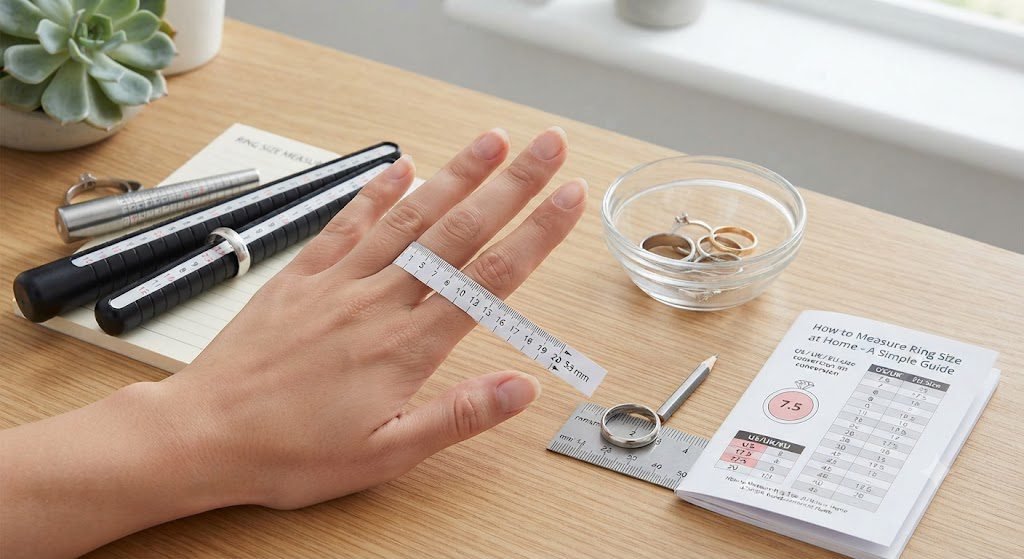
- Cut a strip of paper about 6 inches long and roughly 1/2 inch wide, or use a piece of string/floss of similar length.
- Wrap it around the base of the finger you want to size — this is important, since the base is usually the widest part of the finger and gives the most accurate fit.
- Mark the point where the paper overlaps or crosses itself.
- Lay the strip flat and measure the distance from the starting point to the mark using your ruler, in millimeters.
- Compare that measurement to a ring size chart, which will convert millimeters (or inches) into a standard ring size (US, UK, or EU depending on the chart).
Alternative Method: Measuring an Existing Ring
If you already have a ring that fits well, this method tends to be even more accurate than measuring the finger directly:
- Place the ring on a ruler, laying it flat.
- Measure the inside diameter of the ring in millimeters — from one inside edge to the other.
- Match that diameter to a ring size conversion chart.
This works especially well if you’re trying to size a ring as a surprise, since you can borrow a similar ring the person already wears without asking them directly.
Common Mistakes to Avoid
- Measuring first thing in the morning. Fingers are typically smaller in the morning and swell slightly by evening, especially in warm weather. Measure in the afternoon or evening for a more realistic size.
- Measuring cold fingers. Cold temperatures cause fingers to shrink slightly. Warm your hands first.
- Pulling the paper or string too tight. This compresses the finger and gives a falsely small measurement. It should be snug but not squeezing.
- Only measuring once. Measure 2–3 times and take the most consistent reading.
- Ignoring the knuckle. If the knuckle is noticeably larger than the base of the finger, the ring needs to fit over the knuckle comfortably too — factor this in, especially for wider band styles.
- Using the wrong finger. Ring size can vary between hands and even between fingers on the same hand, so always measure the exact finger the ring will be worn on.
Factors That Affect Accuracy
- Band width: Wider bands (6mm+) typically need to be sized slightly larger than thinner bands because they cover more surface area of the finger.
- Time of day and temperature: As mentioned, fingers naturally fluctuate in size throughout the day.
- Weight fluctuations: Recent weight changes, pregnancy, or medical conditions like arthritis can affect finger size and how a ring fits.
- Dominant vs. non-dominant hand: Many people find their dominant hand’s fingers are slightly larger.
Professional vs. DIY Measuring: Which Should You Choose?
DIY at-home measuring is a solid option when:
- You’re buying a lower-cost or fashion ring
- You want a general estimate before an in-person fitting
- You’re sizing secretly as a gift surprise
Professional sizing at a jeweler is worth the trip when:
- You’re purchasing a fine jewelry piece or engagement ring
- The ring has a wide band, unique setting, or will be worn daily for years
- You want the most precise measurement possible, since jewelers use a graduated metal ring sizer that accounts for band width and finger shape in ways paper and string can’t
A reasonable approach many people take: use the at-home method to narrow down the size, then confirm with a jeweler’s sizer before finalizing an important purchase.
Safety and Practical Considerations
This is a low-risk task, but a few practical notes:
- Don’t wrap string or paper so tightly that it cuts off circulation, even briefly.
- If a finger is swollen due to injury or medical condition, wait until swelling subsides before measuring, or the size won’t be accurate for normal conditions.
- Ring sizer apps that use your phone screen for calibration can be helpful, but screen sizes vary — cross-check with the paper/string method for confirmation.
Maintenance Tip
Once you know your ring size, note it down (phone notes app works fine) along with the date measured. Sizes can shift slightly over months or years due to weight changes or age, so it’s worth re-measuring every year or two, especially before a significant purchase.
Conclusion
Measuring ring size at home is straightforward once you know the right technique: measure the base of the finger (not the knuckle), do it later in the day when fingers are at their natural size, and cross-check with an existing ring if you have one available. For everyday rings, this method is generally accurate enough. For higher-value or hard-to-resize pieces, it’s worth following up with a professional jeweler’s measurement before you commit to a purchase.
Frequently Asked Questions
1. What’s the most accurate way to measure ring size at home?
Measuring an existing ring that already fits well tends to be more accurate than measuring the finger directly, since there’s no risk of pulling the string or paper too tight.
2. Does ring size change over time?
Yes. Weight fluctuations, age, temperature, and medical conditions can all cause finger size to change gradually. It’s worth re-measuring periodically.
3. Should I measure my finger in the morning or at night?
Measure in the evening when fingers are at their largest natural size for the day, to avoid ending up with a ring that’s too tight later on.
4. How much does ring size typically vary between fingers?
It can vary noticeably — often by a full size or more between the same finger on each hand, or between different fingers on the same hand.
5. Can I use a printer-based ring size chart accurately?
Yes, as long as you print it at 100% scale (no “fit to page” settings), since scaling can distort the measurements and throw off the size.
6. What if my ring size falls between two sizes on the chart?
When in between sizes, most jewelers recommend sizing up slightly rather than down, since a ring that’s a touch loose is generally more comfortable than one that’s too tight.
7. Is it possible to size a ring for someone without them knowing?
Yes — borrowing an existing ring they wear on the correct finger and measuring its inside diameter is the most common way to do this discreetly.
8. Do wider bands need a different size than thinner bands?
Often yes. Wider bands can feel tighter than thinner ones at the same size, so many jewelers recommend going up half a size for bands wider than 6mm.