

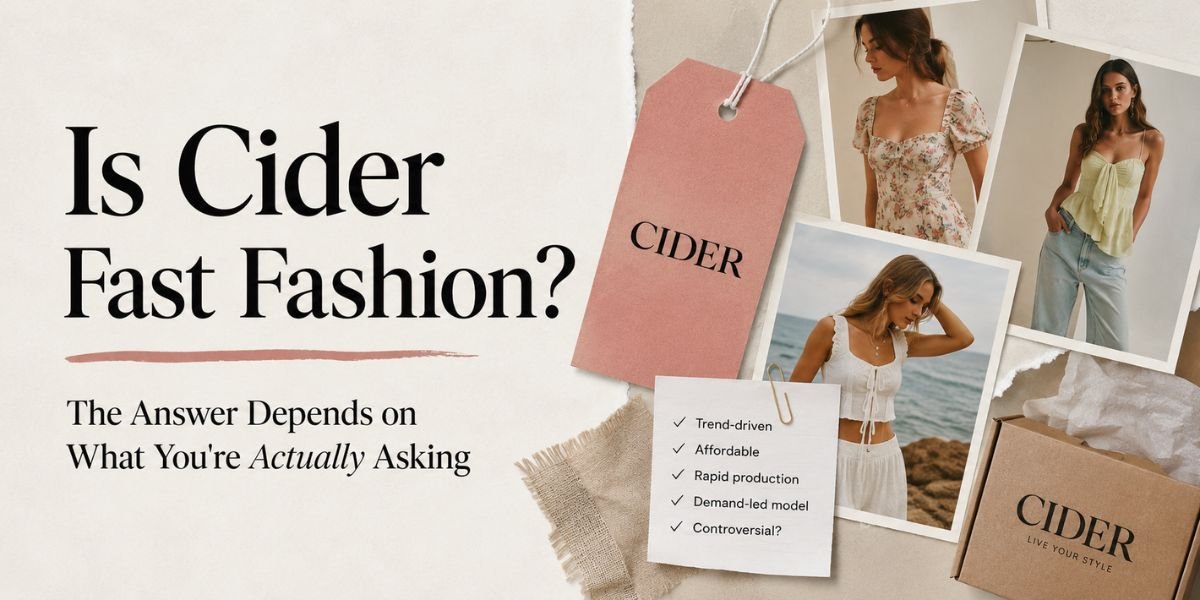
Cider arrived in 2020 calling itself a “sustainable fashion community,” which is one of those phrases so strategically imprecise that it tells you almost everything you need to know before you’ve looked at a single product.
The brand’s model — drop-based, algorithmically curated, priced between $12 and $45, shipped from China with a homepage that rotates “limited” styles weekly — maps onto fast fashion in nearly every structural way. But whether Cider is fast fashion depends on which definition you’re using, and that semantic argument has been doing significant work in the brand’s marketing for four years. The more useful question isn’t classification. It’s accountability: what does Cider’s business model actually cost, and who pays it?
Style Snapshot
- BrandCider (CIDER), founded 2020, headquartered in Los Angeles with primary production in China
- Business ModelSocial-first, drop-based fast fashion; approximately weekly new-style cadence with on-demand and small-batch production claims
- Price Point$12–$45 per garment; direct-to-consumer, no wholesale, no physical retail as of 2024
- Supply Chain TransparencyNo named factories publicly disclosed; sustainability page describes broad principles without third-party certifications or audit disclosures
- Production ClaimMarkets itself as “on-demand” to reduce overproduction — claim has not been independently verified
- Aesthetic ModelAlgorithmically derived trend translation; styles track TikTok micro-trends with a 3–6 week turnaround typical of Chinese ultra-fast fashion infrastructure
- Cultural PositionCompetitor set: Shein, Zara, Princess Polly; positions itself as more considered than Shein while functioning on a similar production rhythm
- Why It MattersCider represents the new fast fashion playbook — sustainability language layered over an unchanged structural model — and understanding that gap is the actual consumer literacy question
The “On-Demand” Claim Does Most of the Heavy Lifting
Cider’s central sustainability argument is that it produces in small batches, testing styles before committing to volume — a model it describes as “on-demand” production. The logic is that this reduces overstock and therefore waste, which would differentiate it meaningfully from the landfill economics of Shein’s bulk-manufacture model.
The problem is that “on-demand” in this context is a relative and unverified claim. Cider has not disclosed factory partners, published production volume data, or commissioned independent audits that would substantiate the assertion. What the brand has disclosed is that it adds hundreds of new styles monthly and ships globally from Chinese manufacturing infrastructure — the same infrastructure that enables the speed and price point it operates at. A small initial run that scales rapidly on a successful style is still, structurally, fast fashion. It’s fast fashion with a better editorial team.
Speed and Price Are the Architecture, Not the Aesthetic
There’s a tendency — particularly among brands targeting Gen Z consumers who’ve developed sophisticated sustainability fluency — to treat aesthetic distance from Shein as ethical distance from Shein. Cider’s photography is considerably more considered than Shein’s. Its editorial language borrows from indie fashion’s vocabulary of “community” and “self-expression.” Its color palette and styling references have genuine taste behind them.
None of that changes the underlying economics. At $14 for a woven blouse, the fabric, construction, finishing, labor, and logistics cost structure is not compatible with living wages and responsible material sourcing at the same time. I’ve spent enough time in production conversations to know that a $14 retail price on a shipped garment leaves almost nothing for the person who made it. The aesthetics are a surface. The price point is the structure.
What the “Sustainable Fashion Community” Framing Actually Signals
When a brand leading with community and sustainability also operates a referral program, a TikTok affiliate network, and a micro-influencer seeding strategy at volume, what it has built is a marketing architecture that converts the language of conscious consumption into a growth funnel. That’s not cynicism — it’s just reading the business model accurately.
The brands genuinely operating outside the fast fashion structure — Bode, Entireworld before it shuttered, Christy Dawn with its farm-to-closet transparency — have one thing in common: their supply chain transparency is specific enough to be verified and uncomfortable enough that they don’t lead with it in their Instagram bio. Cider’s sustainability language is broad, aspirational, and unaudited. That pattern has a name in this industry. It’s called greenwashing, and it’s become sophisticated enough that it now sounds like the values it’s imitating.
The Classification Question Is the Wrong Question
Cider is fast fashion by every structural measure that matters: price architecture, trend velocity, production geography, supply chain opacity, and volume of new styles. Whether a specific consumer wants to call it that is a values negotiation, not a factual dispute.
What’s worth watching is how regulators respond to this generation of brands. The EU’s Green Claims Directive, which moves toward enforcement in 2026, will require brands operating in European markets to substantiate sustainability claims with evidence or face legal consequences. That’s the pressure point. Not consumer discourse on TikTok — legislative specificity about what “sustainable” is actually allowed to mean. If Cider’s claims survive that scrutiny, the conversation changes. If they don’t, the brand will have to choose between its price point and its positioning. That choice will be more revealing than anything on its about page.
Read More: How Do I Contact Fashion Nova Customer Service Number 24/7